While large-scale campaigns aim for maximum reach, our regional campaigns focus on minimizing wasted impressions and targeting audiences efficiently. Fewer wasted impressions mean a more effective use of the advertising budget and, ultimately, better results.
How can wasted impressions be avoided?
We need to let go of the ambition of creating a campaign with absolutely no wasted impressions. Print media and direct mail campaigns inevitably reach people who are not part of the intended target audience. If you choose Google Ads or try your luck with social media strategies, you can define your audience very precisely in advance, but potential customers on the margins of that audience may still be missed. In such cases, minimizing wasted impressions can also mean reaching only a small portion of the potential target group.
Using our client Uhlala as an example, we can demonstrate how thoughtful planning can help minimize wasted impressions while moving closer to the desired audience.
The situation: Uhlala operates in the LGBTIQ+ social business sector. Its activities include promoting inclusive corporate cultures, providing leadership training, and running job and career platforms. The target audience consists of both open-minded companies and LGBTIQ+ job seekers. Outdoor advertising has the advantage of reaching both groups.
In Berlin, there are several neighborhoods with a significantly higher concentration of LGBTIQ+ residents and visitors than other residential and entertainment districts.
Who doesn’t remember Klaus Wowereit strolling around Nollendorfplatz in Schöneberg, surrounded by journalists? The Lesbian and Gay City Festival has long been a celebrated tradition there. Kreuzberg and Neukölln, meanwhile, are known for attracting a younger LGBTIQ+ community. These three districts therefore became the primary candidates for the campaign.
In the end, Moritzplatz was selected—a location widely regarded as a central hub of the scene.
Get closer to your audience through precise selection
Call us or send us an email with details about your target audience. Audience-specific selection is our passion.
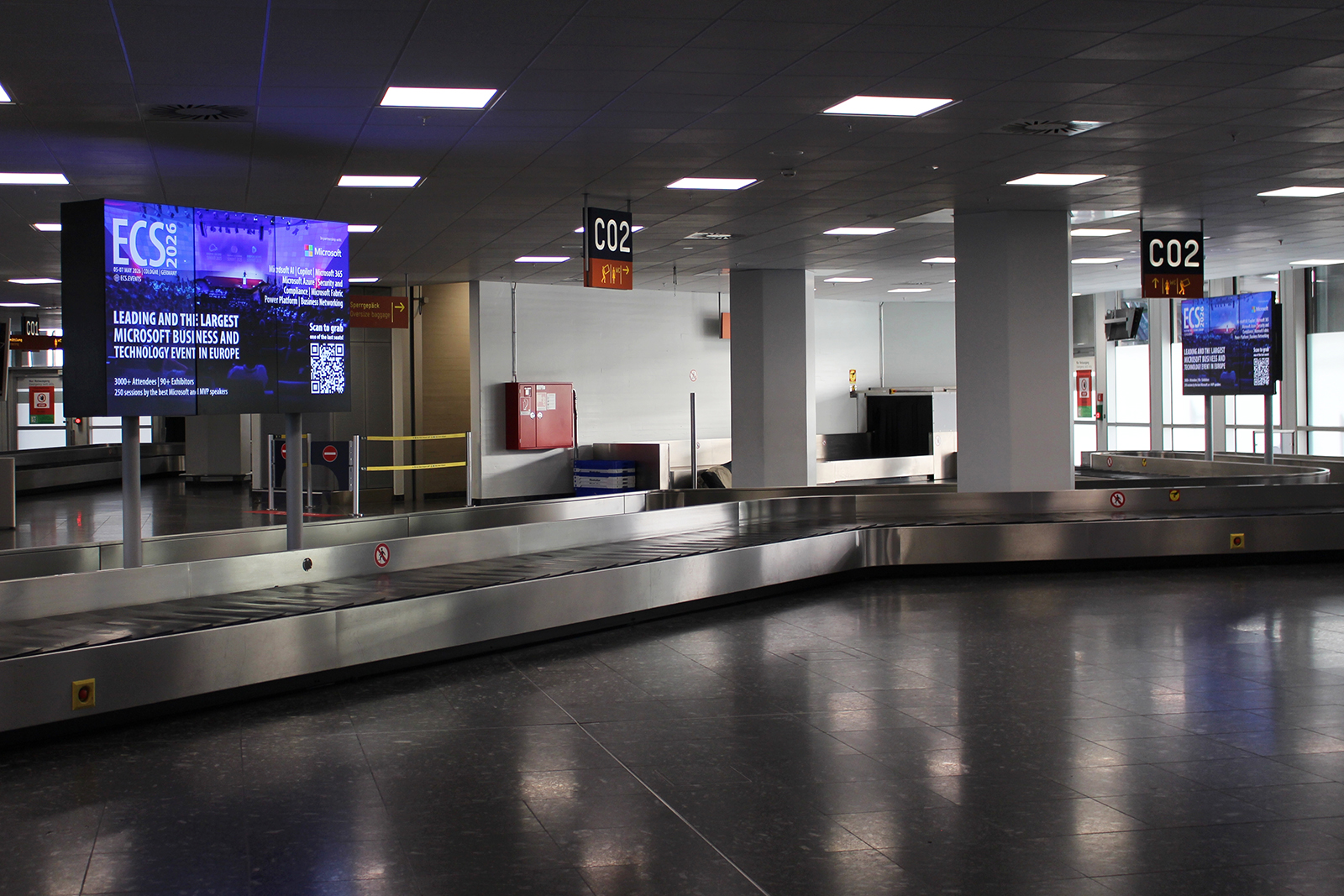
Did you know that travelers at Cologne Airport spend an average of 35 minutes at the baggage carousels? That is longer than a lunch break!
This is exactly where our client ecs.events reached their target audience with airport advertising.
From May 5 to May 7, 2026, the ECS Congress will take place in Cologne. ECS, what does that stand for? European Collaboration Summit. With 3,000 participants, ECS is the largest conference worldwide on Modern Work, Microsoft 365, and Copilot. Therefore, no less than Microsoft is a partner of this event. The event takes place at Confex, the conference center that opened less than two years ago directly on the Cologne exhibition grounds. Here, over 3,000 participants and more than 90 exhibitors come together to fill the three days with more than 250 sessions.
The campaign for ECS started 5 weeks before the event. Its aim is to generate attention early and to boost ticket sales for the congress. ECS opted for 20 digital screens at the baggage carousels of Terminals 1 and 2 at Cologne Airport. By choosing this form of outdoor advertising, the campaign not only offers high visibility but also a high degree of flexibility:
Thanks to the digital screens, the client was “on air” within a week despite the short notice submission of the design. The campaign was optimally aligned with the date of the congress and the client’s objectives.
For the client, there is a high level of flexibility in creating the designs: depending on the campaign goal, the quickly implemented design can have a different focus: increasing sales as for ECS, image advertising, product launch, and much more.
The travelers at the airport, many of whom are traveling for business and are therefore part of the target audience relevant to our client, were reached. Placement at the baggage carousels ensures high visibility in an environment with low scatter loss and long dwell time.
The airport advertising campaign with a 10-second spot ran from March 30, 2026, to April 5, 2026, with at least 720 plays per day between 4:00 a.m. and 12:00 a.m.
The best part: the campaign can be booked for a price of under 5,000 euros.
Not only fast and flexible but at a top price! Sounds like a great opportunity to make your message visible, right?
We implement your campaign for you and are happy to advise you.
The more people live in one square meter, the more important public transport becomes. Congested streets and lack of parking speak for the use of buses and trains in the city centers of Germany. 78% of the population use public transport, and not only in very young target groups.
Why indoor advertising?
• High reach
• Long “advertising time”: at least 10 minutes travel time
• 42% of respondents state that they notice advertising in buses and trains (see study by the Fachverband Aussenwerbung)
What types of indoor advertising exist?
Sizes and shapes vary from city to city, from vehicle to vehicle.
Bus indoor advertising: Most buses are single-deckers or articulated buses, double-deckers are the minority. In many cities, the windows can be covered with double-sided printed films in the format 50 x 15 cm. The advertising can be seen from both inside and outside. In some bus types, the partition behind the driver is offered in a portrait format.
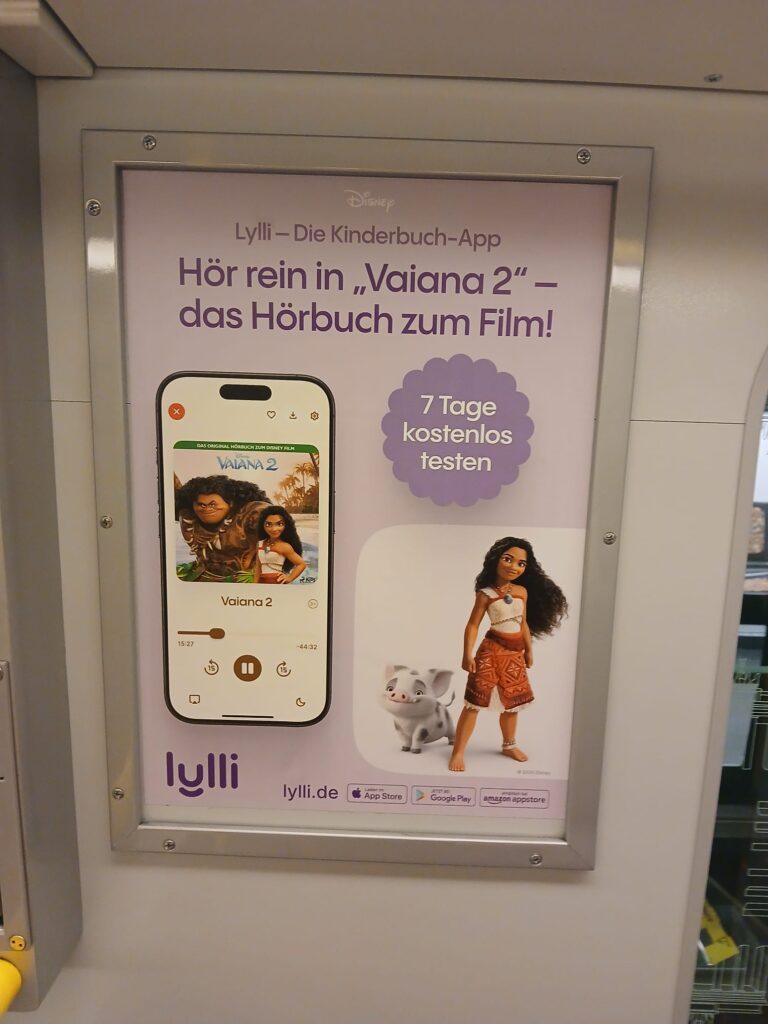
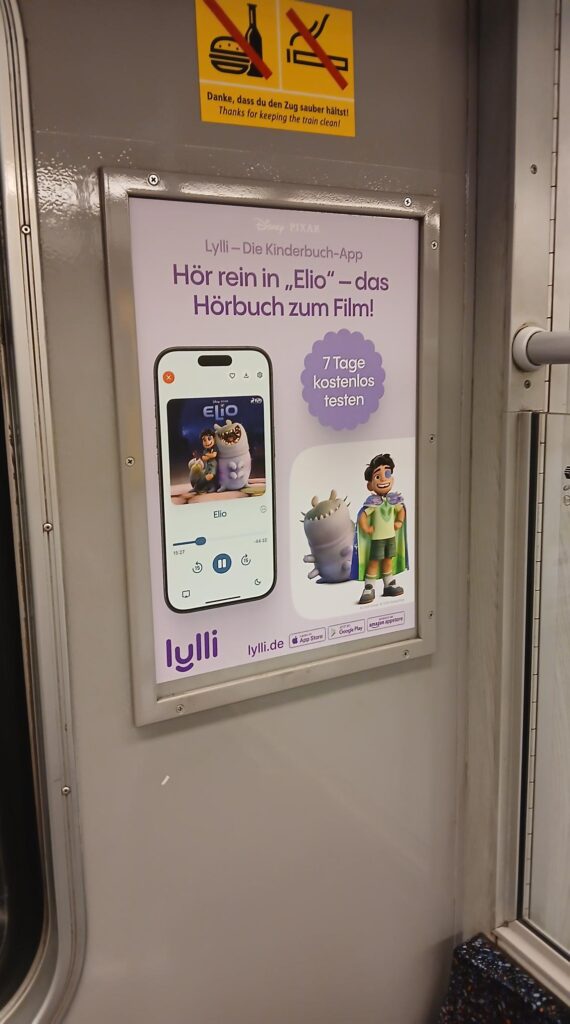
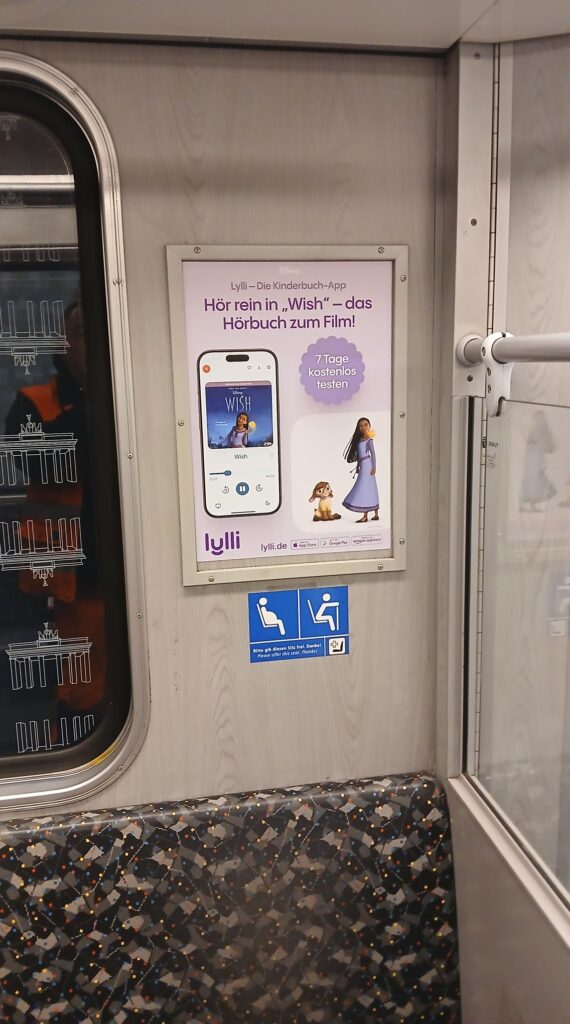
Train indoor advertising: In trains we find most of the surfaces. Above the seats, landscape-oriented strips dominate, which offer less space for complex advertising messages, but relieve the budget. Images and texts are best placed on the end walls of the carriages and next to the doors.Another quite common format is the A2 portrait format, which is placed next to the doors and on the end walls of the carriages
The publisher Lilly used the format 285 x 405 mm and presented its children’s book app. The images were meant to have impact, which is why the publisher chose a portrait format and a sufficiently large size.
Indoor advertising is available in practically every German metropolis. Whether Berlin, Munich, Stuttgart, Hamburg, Hanover, Leipzig, Dresden, or Nuremberg, advertising spaces can be booked in all subways, trams, and buses, although without line binding. In rural areas, public transport is provided through a network of bus lines and regional trains. The range of indoor advertising is therefore significantly thinner. In this case, we recommend checking the advertising opportunities at the stations.
We are happy to advise you and implement your advertising goals efficiently.
You might think 2025 was a tough year for the advertising industry. Budgets were cut, major media categories lost ground, and TV (the dominant medium for decades shed nearly €722 million. Not exactly a climate for growth. And then there is out-of-home advertising. While other media tightened their belts, out-of-home in Germany grew by almost 10%, adding over €320 million in absolute terms — more than any other category. This is not a one-off. It is a trend.
The market in brief
The German advertising market totalled around €35.4 billion in 2025, a slight decline of 0.5% year on year. TV was down 4.2%, cinema down 0.8%. Online and print both grew, but modestly, at 1.6% each. Radio held steady at +0.3%.
OOH, by contrast, closed the year at €3.557 billion. Over the summer, its market share crossed the 10% mark for the first time and held it through to December. Even in December, traditionally TV’s strongest month, out-of-home grew by another 10%. These figures come from the official Nielsen advertising statistics, analysed by B|A|M Bundesverband Aussenmedien e.V.
So what makes OOH so attractive right now? In short: out-of-home advertising reaches people when they are out and about — and let’s face it, that is most of the time. It meets them in their daily lives, on the way to work, while shopping, around the city. Not squeezed between ad breaks or buried in a social media feed.
Digital is the new normal
Even more striking than overall OOH growth is what is driving it. Digital out-of-home, meaning digital screens and displays in public spaces, grew by 26% in 2025. Traditional poster advertising, on the other hand, dipped slightly at -1.5%.
The result: the digital share of total OOH revenue climbed from 41.5% to 47.6%. The 50% milestone is almost within touching distance.
This means that today, almost one in every two euros spent on out-of-home advertising goes into a digital format. And for good reason: DOOH combines the reach of a classic poster with the flexibility of digital advertising. Campaigns can be activated at short notice, adjusted by time of day or weather conditions, and updated at any time. In a market where agility matters, that is a serious advantage.
City Light: the star of the statistics
Within the poster segment — at €2.351 billion the largest area of OOH — City Light formats have clearly taken the lead, posting growth of 24.1%. The format closed the year at €1.164 billion, more than all other poster formats combined when large-format and City Light Board are added together.
This comes as no surprise. City Lights are located where people spend their time: in pedestrian zones, at train stations, at busy junctions. They are at eye level, well lit, and in their digital form as DCLP, dynamically programmable. For anyone looking to be seen in city centres, they are hard to ignore.
Who is investing and why interest keeps growing
Particularly notable is which industries significantly increased their OOH budgets in 2025. Travel and tourism, for example, was up 67.9%. Someone looking to book a summer holiday walks past posters — they do not scroll through an algorithm. Transport and logistics grew by 48.7%, arts and culture by 28.3%, and retail by 16.8%.
The trend is equally clear at company level: REWE increased its OOH budget by 55.6%, Amazon by 33.6%, and ILS by as much as 56.3%. These are not newcomers testing the water, these are household names doubling down on out-of-home.
Stations: advertising in the moment of waiting
Within transport media, advertising at train stations, metro stations and other transport infrastructure, station advertising stands out. At nearly €700 million and growth of 5%, it is the strongest individual segment within transport media.
Anyone who has ever waited for a train knows why it works. Your eyes wander naturally and land on advertising spaces designed precisely for that moment. No smartphone notifications competing for attention, no scrolling past. Just: there, look, register.
Out-of-home in 2026: what to expect
All major media agencies agree: OOH will remain on a growth trajectory. Even as the economic environment becomes more challenging, the outlook for out-of-home advertising remains positive.
Digitalisation will sustain this momentum. DOOH is not just growing, it is fundamentally reshaping the medium, towards greater flexibility, more data-driven targeting, and more opportunities for advertisers of every size. The street has always been the most direct route to people. Now it is becoming the smartest one too.
Television in buses and trains is infotainment consisting of news, advertising, and current weather reports. Information about sports and culture is well received by passengers and forms the basis for attractive advertising. Several screens are installed in each carriage, so the program reaches every passenger, regardless of where they are standing or sitting. The systems hardly differ. If dual monitors are installed, one screen displays a chain of information from the transport company, while the other screen broadcasts infotainment. This keeps passengers’ attention high.
Where is passenger TV available?
Passenger television is available in Germany primarily in large cities such as Berlin, Munich, and Stuttgart, but also in cities such as Hamburg, Hanover, Leipzig, Dresden, Chemnitz, and Nuremberg in subways, trams, and buses. As a rule, there is one screen for infotainment and one for advertising. One thing they all have in common is that the program runs without sound so that passengers are not disturbed or annoyed by noise.
Target groups to select
Public transport is particularly popular in metropolitan areas. The number of car owners in large cities has been declining for years. Congested roads, parking restrictions, and constantly rising maintenance costs are arguments against owning a car. In addition, the mobility study by the Federal Ministry of Transport states that mobility is increasing every year. People are spending more and more time outside their own four walls. Passenger television allows you to reach a mobile target group.
In all metropolitan areas, passengers tend to be slightly more female, slightly younger, and have a household income above the average for the city in question.
Some cities offer advertising for the next stop. This is an ideal advertising space for local businesses. “Get off at the next stop and go shopping.”
Booking according to time slots allows for even more efficient targeting of the target group. Shopping customers do not travel by train. Time slots from 10 a.m. onwards are therefore recommended. From 10 p.m. onwards, we mainly encounter young people.
Patronage bookings can also help to finalize the target group. Sports or book of the month divide passengers into sports-minded and/or culture-minded viewers.
The choice is yours.
How do I book passenger television?
The format is an MP4 file. The minimum length is 10 seconds, but we recommend 15 seconds. Passengers’ attention is subject to distractions. The person next to them might be tapping their foot, the train might stop or start again. Their eyes are not fixed undisturbed and spellbound on the monitors. That’s why the images and messages need to “stand” a little longer than in your own living room.
Bookings are made in days, time slots, and spot length. Depending on the city, the spot is broadcast in two- or three-hour cycles. The time slots represent different contact numbers and different prices per second. The rule of thumb is that more contacts and higher reach lead to higher prices per second, just like with TV formats from private and public broadcasters. A different time slot every day is no problem.
The last adjustment is the number of repetitions. The standard is around 8 repetitions per hour. For high advertising impact, we recommend doubling the number of repetitions.
Final note: The commercial must be submitted one week in advance for approval. Advertising in public spaces is subject to strict rules, but 98% of advertisers comply with them without any problems. Strict rules apply to sexist, political, and religious statements.
Here is our example of the month on the topic of AIDS (Jauary 2026):
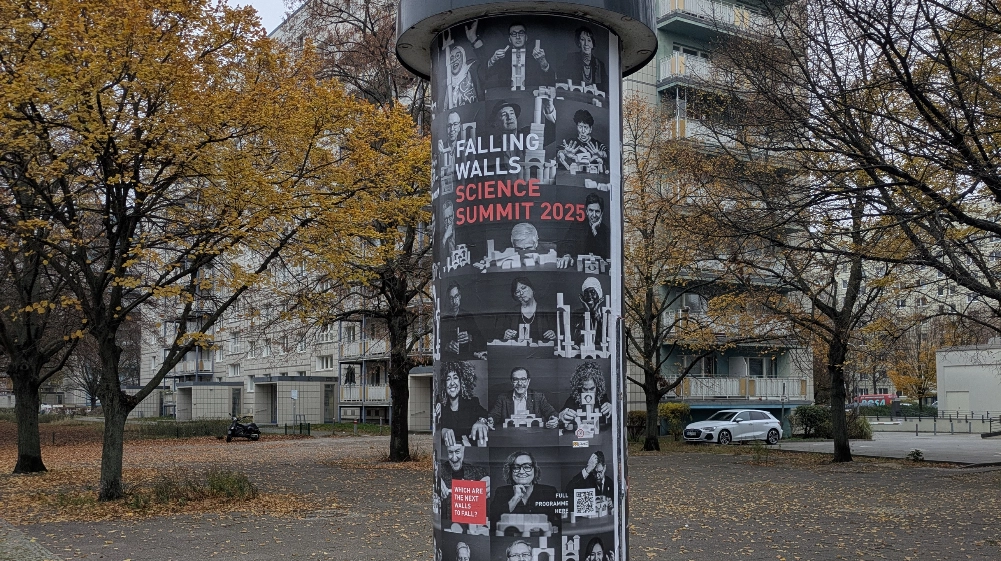
Berlin Science Week is a week for anyone who’s curious – all over Berlin. Science opens its doors for 10 days.
Our client figured this message needed to get out there, and outdoor advertising was the best way to do it, so they picked their spots. In addition to classic large-scale (paper) advertising, they also opted for City Light columns. These are modern, backlit advertising columns with 360-degree visibility, located exclusively in high-traffic locations. Three posters can be hung in the columns. Each poster has the same chance of visibility, as many models rotate. The posters are illuminated from the inside, which extends the advertising time, especially in fall and winter.
The facts at a glance:
Backlit advertising: The posters are illuminated from behind, making them particularly visible.
360-degree visibility: The posters are clearly visible from all directions.
Location: Always in high-traffic locations.
Rotation: Many models are rotating models.
Weatherproof: The posters are protected from the elements in weatherproof display cases.
Booking: Individually or in networks.
We wish Science Week a flood of curious people who will enrich the free events for ten days and transform Berlin into a hub of scientific experiences.