Sometimes things have to go quickly. Large campaigns with print posters or transit advertising often need at least 4 to 8 weeks lead time. If you don’t have that much lead time, digital City Light Posters are the best choice.
10 positive reasons for digital City Light Posters:
Networks with digital City Light Posters now exist in almost all major cities in Europe.
Positioniong in city centers and near public transport guarantees high contact chances and multiple contacts.
The CLP format is the same in most cities, so the same spot can be broadcasted throughout Europe (1,080 x 1920 pxl)
Digital CLPs can be booked spontaneously with a short lead time. Only a few days before the start of the campaign, available slots can be booked and the spots can be programmed.
The digital screens are super suitable for short campaigns. Minimum booking: 1 week, sometimes even only 1 day.
They can be booked with fixed spot playout or programmatically.
You can have several spots broadcasted and occupy several slots.
The screens benefit from high attention rates through moving images.
The high resolution and best image quality make your brand shine
The digital City Light Poster is a premium advertising medium and thus supports the image of the advertiser.
So digital City Light Posters shine with their flexibility and great advertising impact. That’s why, for the opening of their new store at Place de la République in Paris, Adidas had opted for a campaign on digital City Light Posters in the metro. Very good choice!
It should be clear to most people that education is an important step toward success. In addition to state colleges and universities, there are also a vast number of private institutes, as well as training and continuing education programs. But in which institute should I visit which classes or training? In order to assert themselves in the highly competitive market for pupils and students, many Berlin institutes for further education count on interior advertising in public transportation: Bus, trams, S-Bahn and U-Bahn.
Why is indoor advertising such an excellent way to find new students?
Berlin has a safe and well-branched transportation network
Many people commute to work and school, due to lack of parking in the city -> extremely high reach (Berliners & commuters)
1.5 million people use the subway daily -> Transit advertising = mass medium
Indoor advertising can be booked in various formats and for as little as 50 slides for 1 month or more -> cost effective way reach many multiple contacts
foils are durable -> short campaigns and annual booking possible
always illuminated and visible, day and night
Through indoor advertising, you can reach a large number of people who are not only potential clients themselves, but could also be parents who, as co-decision-makers, have an influence on their children’s education.
Side stripes, front wall posters, side wall posters or rather ceiling posters?
Interior advertising is an effective way to fill courses and degree programs. That’s why some of our partners swear on interior indoor advertising. But which format is the most fitting? The landscape-format foils above windows and doors in the subway are called side stripes. They are inexpensive and bookable in large numbers. To generate even more registrations for the start of the semester in the fall, Berlin Kolleg die BBW Hochschule, die Emil Molt Akademie and Euro Akademie each recently launched a campaign with side stripes in the Berlin subway (U-Bahn).
Since the side stripes offer only little space for details, BBW Hochschule has additionally occupied the large front wall poster surfaces. These portrait-format front wall surfaces offer plenty of space for information on registration or individual courses of study. Damago opted for a mixture of formats and placed itself both on the narrow side strips, the huge end wall panels and the medium-sized side wall panels in the subway, as well as on the large landscape-format ceiling posters in the suburban train (S-Bahn).
We wish our partners good luck at filling the classes and study programs!
Complete lockdown and nobody is on the street? False! Mobility monitoring clearly shows that there is no zero level and people are still on the road. With a case study, the geolocation app GIM Traces and the Digital Media Institute also prove that the advertising impact and brand awareness of campaigns with digital outdoor advertising achieve extraordinary values despite lockdown.
In the case study, the advertising impact of two campaigns for the Hylo Eye Care product (trademarked brand of Ursapharm) was compared (2019 vs. 2020). The digital spots were shown on 80,000 screens. These so-called touchpoints were, for example, screens in pharmacies, in retail stores, at subway stations and in doctors’ waiting rooms. To measure the advertising impact, telephone and online surveys were used, as well as geo-data from the GIM Traces app from several thousand app users who had previously agreed to geo-tracking.
Question: Does digital outdoor advertising make sense during a lockdown?
Study answer: Yes!
Despite lockdown, people continue to go to work, shop, visit the doctor, or exercise outdoors. In 2020, as many as 62 percent of all people tracked had at least one contact with a touchpoint. In total, that was just 3 percent less than the previous year. And that, despite lockdown!
The strong results in terms of brand recall and awareness are also attributed not only to motifs with well-known soccer players, but also to the fact that a stimulus-reduced environment leads to greater attention to the screens.
Conclusion of the study: Digital out-of-home advertising (DOOH) offers enormous potential for products and brands even in lockdown and difficult advertising phases. No wonder, then, that the share of digital advertising media in outdoor advertising is already at 35% and continues to rise. After all, digital outdoor advertising achieves an outstanding advertising impact and increases brand awareness.
Mall Videos and City Light Posters in Shopping Centers
The Spring collection is eagerly waiting for the opening of retail and department stores
Everyone is eagerly awaiting the comeback of normality and the opening of retail, restaurants and Co.. We finally want to go shopping and treat ourselves. When the malls and shopping centers of the big cities are allowed to open their doors again, especially experience-hungry shoppers will roam the aisles.
In many shopping centers and malls, there are digital and analog advertising spaces that accompany shoppers on their way through the rows of stores and in the parking garage and can set direct buying impulses: the so-called Mall Videos and City Light Posters in ShoppingNet.
Mall Videos – digital shopping companions
With Mall Videos, you have the opportunity to present your advertising message directly to shoppers in many German shopping malls on digital advertising screens in portrait and landscape format. The average length of stay in the center is 90 minutes. Perfect to generate countless multiple contacts with mall videos and to set buying impulses directly at the point of sales (POS). Mall videos are flexible because you can chose time slots and book small networks per center. In this way, you hit your target group exactly.
City Light Poster (CLP) in shopping centers and parking garages
In addition to digital screens, many German malls and shopping centers also offer the option of using analog poster spaces: City Light Posters in the ShoppingNet. The City Light Posters accompany the shopper through the shopping aisles, at entrances and exits, and on the way to the parking garage. City Light Posters are available in small networks per mall. Therefore, the advertiser can control exactly in which environment they are present. This way, you can set buying impulses or address your target group from the local area.
Plan now for the malls to open soon
Particularly digital networks can be booked at short notice. If available and the posters have already been produced, CLP ShoppingNet can also be booked at short notice This allows you to react spontaneously to the opening of shopping centers and malls and target shoppers hungry for consumption.
.
Sample prices
The prices for mall video spots are variable depending on the choice of time slots and playout frequency. Depending on the location, from €292.91 per week.
Here are a few specific examples of City Light Posters in ShoppingNet:
City
Shopping Center
visitors/ week
net size
price per net/ week
Berlin
Eastgate
125286
10 CLP
1.750,00 €
Berlin
Gesundbrunnen Center
176970
12 CLP
2.100,00 €
Berlin
Linden-Center
118704
8 CLP
1.400,00 €
Berlin
Ring-Center II
116910
7 CLP
1.225,00 €
Berlin
Märkische Zeile
310914
3 CLP
525,00 €
To find out which center mall offers videos and CLP shopping networks, simply send us an e-mail. We will gladly send you concrete offers and availabilities. We are looking forward to your request.
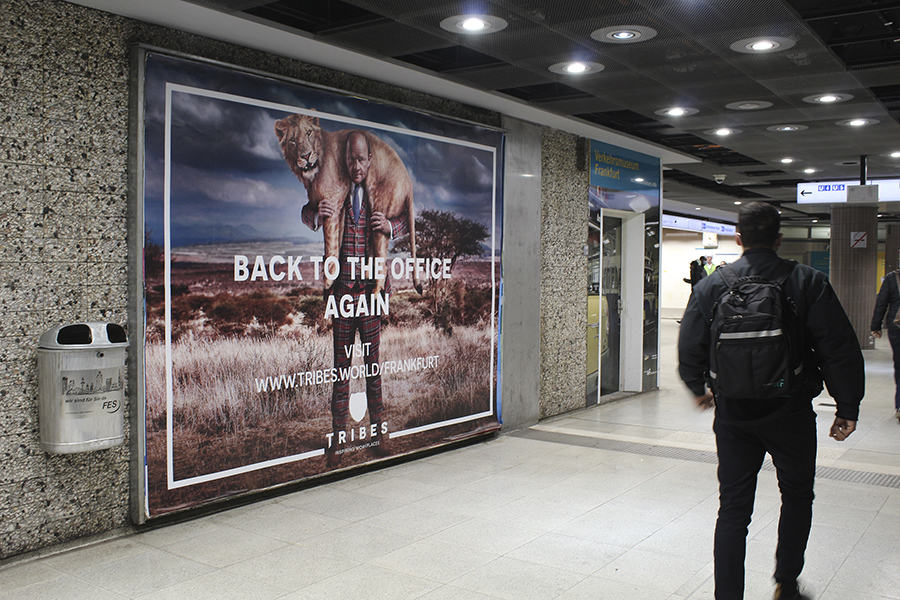
TRIBES advertises their new co-working office in Frankfurt with billboards and bus advertising.
The slogan “Back to the office again” can currently be found on billboards and bus advertising in downtown Frankfurt. TRIBES is advertising for their new co-working office in the Marienforum. Here you can rent individual work desks, private offices, meeting rooms and entire floors on a permanent basis or just by the day. Great for all those who are no longer in the mood for home-office anymore.
As an opening campaign for the new location, TRIBES placed targeted billboard advertising on various large-scale billboards in the streets and train stations near the new co-working office in downtown Frankfurt. In addition, the motif was also placed in traffic board format on buses and is rolling through the city.
Large-scale billboards and traffic boards – the perfect duo for the graphic designer and media planner
Putting together an effective media mix for an advertising campaign is not always easy for media planners. The more different media you include, the more work it means for the graphic designer, who has to adapt the motif to a wide variety of formats. However, large-scale billboards and traffic boards are a particularly good duo.
Large-scale billboards are the classic in poster advertising and can be found all over Germany on the streets and in train stations. Thanks to their standardized 18/1 format, the graphic designer can sit back and relax, because he or she only has to create the motif in one format. Even if bus advertising in traffic board format is added, the graphic designer does not have to panic: traffic boards are also available in 18/1 format. The only thing to keep in mind here is that the vehicle notches do not interfere with important text or image elements.
It is not just the same format that makes large-scale billboards and traffic boards a perfect duo, but also how they complement each other in their advertising impact. Large billboards can be selected individually and are therefore ideal for targeted placement around the target group’s environment or around the POI (Point of Interest, in this case the Marienforum). Complementary to billboard advertising at selected locations, bus advertising offers a wide reach and many contacts, as advertising on public transport rolls through the streets incessantly. Thus, targeted large-scale billboards and the strong visibility and reach provided by bus advertising complement each other to form a perfect duo.
You may know it from yourself. When the weather changes, you may well have to deal with migraines – and now our food is suffering the same? Well, almost.
Programmatic Digital-Out-Of-Home (DOOH) stands for “programmatic, digital outdoor advertising” and enables advertising to be played out in real time. Based on data such as location, day, time, traffic, location and/or weather, advertising can be precisely played out to specific target groups.
So it could be that on a rainy and cool afternoon hot soup is advertised on a digital City Light Poster by a delivery service. But on a sunny and warm evening, only the partner companies in the immediate vicinity are advertised by the delivery service. Welcome to the future? Welcome to the past: As early as 2018, the delivery service Foodora had already distributed various spots to target groups via the ECN network, using geo-targeting, weather analyses and data based on the time of day. The dynamic playout through data triggers, which carried out the programmatic DOOH bookings, were a complete success!
Which data is already flowing into the planning today?
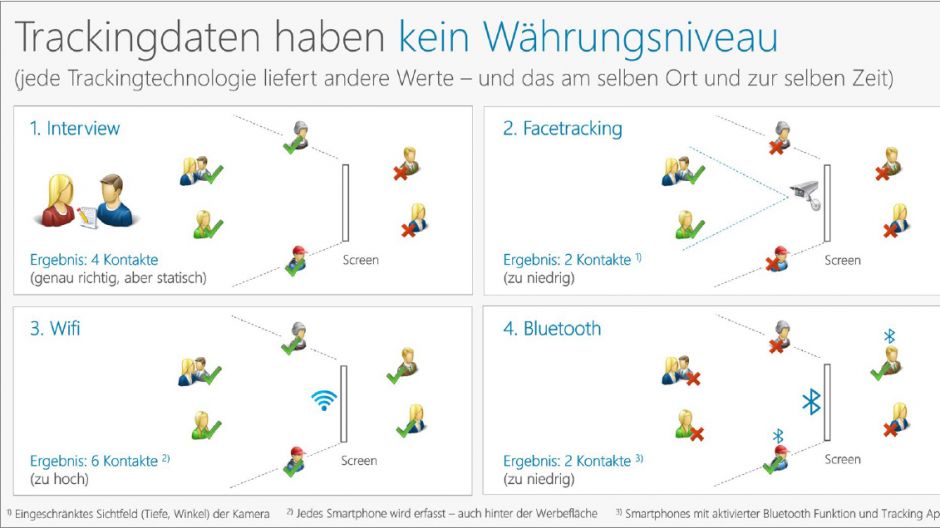
WiFi Tracker: A small inconspicuous box – a WiFi Tracker measures in real time how many people are currently in the vicinity of the advertising medium.
GPS: With GPS positioning, the mobile devices in the immediate vicinity are recorded.
Beacon (Bluetooth): Small transmitters that send their identifier to nearby portable electronic devices. The technology enables smartphones to perform actions in close proximity to a beacon.
Facetracking: Who had eye contact with the advertising motif? Male or female?
The classic surveys are becoming increasingly redundant. The combination of all collected data provides reliable data for planning. With these granular frequency data a programmatic control of digital advertising is possible.
The collection of the data is fully compliant with data protection and does not violate it, as only frequency is determined and no personal information is obtained. The optical sensors, which are used for face tracking, do not record any videos, but only single sequences which for example recognize the gender or the age. Whether the advertising was consciously perceived or not can also be recorded.
The future of Programmatic DOOH includes “location based services“, a cooperation with app providers, which should make it possible to track the paths of users. This would already be data-compliant today for apps that advertise with bonus points, as the use of the application already constitutes consent to tracking.
Our conclusion: DOOH has arrived in the Champignon League!
The recording of target group data in real time thus provides the almost perfect basis for Programmatic DOOH: reduction of wastage, optimization of campaigns according to parameters such as weather and/or time of day, and all this combined with a brilliant appearance. Advertising heart, what more do you want?
The number of screens is growing daily. In the last three years the number has doubled. You can now find them everywhere in: Fitness studios, fast food restaurants, universities or in the waiting rooms of doctors, at train stations, at the airport, motorway rest stops and so on. The digital screens in public places reach almost three quarters of German citizens at least once a week.
How automated campaigns will look like in 2021/2022 and how DOOH will be awarded by auction, you can read in the next part of the series “Programmatic DOOH”.


 Networks with digital City Light Posters now exist in almost all major cities in Europe.