December comes as a surprise, every year. Private individuals get into stress and try to get the remaining Christmas gifts. And companies quickly prepare their annual plans for the coming year. What about your out-of-home advertising annual planning for 2023? What goals has your company set for 2023? More new customers? More repeat customers? More sales?
Out-of-home advertising helps bring new customers to your business. Whether it’s through a permanent lamppost sign with a pole sign or short campaigns with billboard advertising to present offers or new products. Outdoor advertising offers different formats for different advertising goals.
Early planning pays off
You want to place out-of-home advertising for a certain timing or around a certain place, but the desired advertising media are no longer available? Particularly in the case of billboard advertising, the good locations are often booked up well in advance. Especially, at certain events or trade fairs, the relevant advertising faces are often gone quickly. Therefore, it pays to plan in advance.
Do you already know that you will be attending a trade fair in the fall? Then you can book the advertising media for the desired period many months in advance and only worry about the production 1 month beforehand. This way you can be sure that you will be visible at your event and do not have to stress shortly before.
Advertising media for people on short notice
However, there are also some advertising media for those on short notice, where availability rarely becomes a problem. Digital advertising media usually offer 4 to 6 slots for different advertisers. So, the probability is higher that one can still occupy a slot. And since you don’t have to produce posters, lead times are also shorter.
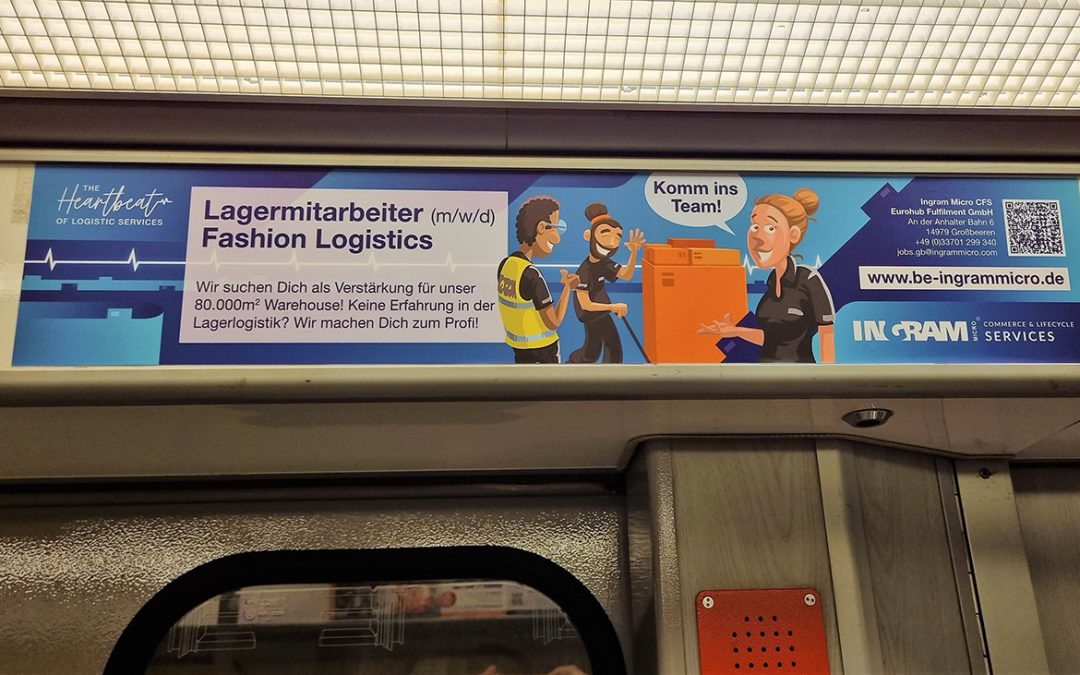
Public transport advertising, such as advertising on or in cabs, trams, buses, subways and commuter trains, also offers many available vehicles for exterior wrapping and designated frames for interior advertising. For example, there are approximately 18,000 slots in the Berlin subway for the format ‘sidestripe’.
Transport advertising cannot be limited locally around a certain small area as billboard advertising around a POS can, but it is great to generate many contacts and create citywide visibility.
Annual plan 2023
So, when it comes to campaigns around a point of interest or for an event, it pays to plan early. And with widespread transportation advertising or digital screens, you can still make use of remaining contingents at relatively short notice. What do you have planned for 2023? Would you like to find out about the new prices or formats? Feel free to contact us. We’ll send you the new presentations and be happy to submit specific offers.
You want to place out-of-home advertising and do not know which media to book, which network or which locations? Two important factors that can help in selecting the advertising medium and locations are the product to be advertised and the associated target group. Out-of-Home advertising is a one-to-many medium. Especially in large cities, a few media can generate millions of contacts. But how qualitative are these contacts? Are they the target group at all or is there high scattering losses?
If your intention with outdoor advertising is general brand awareness, then you simply want to achieve as good visibility as possible and generate many contacts. Your brand is the product, and your target group is not very limited. For large reach in major cities in Germany, transit advertising is very suitable. Buses, trams or suburban and subway trains can be covered with different formats. They are on the road every day, connecting different parts of the city and coming into contact with countless people. Ergo, they provide moving advertising faces for nationwide visibility.
Billboard advertising in major cities can also be used to widely promote a brand as a product. In addition, some poster media, such as City Light Posters, City Light Columns, and City Light Boards, are mostly network media and can be selected individually only in exceptional cases or to a limited extent. Small-format poster advertising (A1 or A0) can also be booked on shared sites only as networks. So, you can also achieve super coverage with these networks.
But the more targeted your product or service is that you want to advertise, the more defined your target group is, of course. If it’s an everyday product, the target audience isn’t particularly narrow. But if the product is only available in a locally restricted area, then the target group is only within a defined radius. Since there is no line binding for most means of transport, or only with surcharges, transport advertising is rarely suitable for locally defined out-of-home advertising. So which media are suitable for a narrow target group? We will show you this using the example of our customer: Cofra.
Cofra – Italian safety shoes in Germany
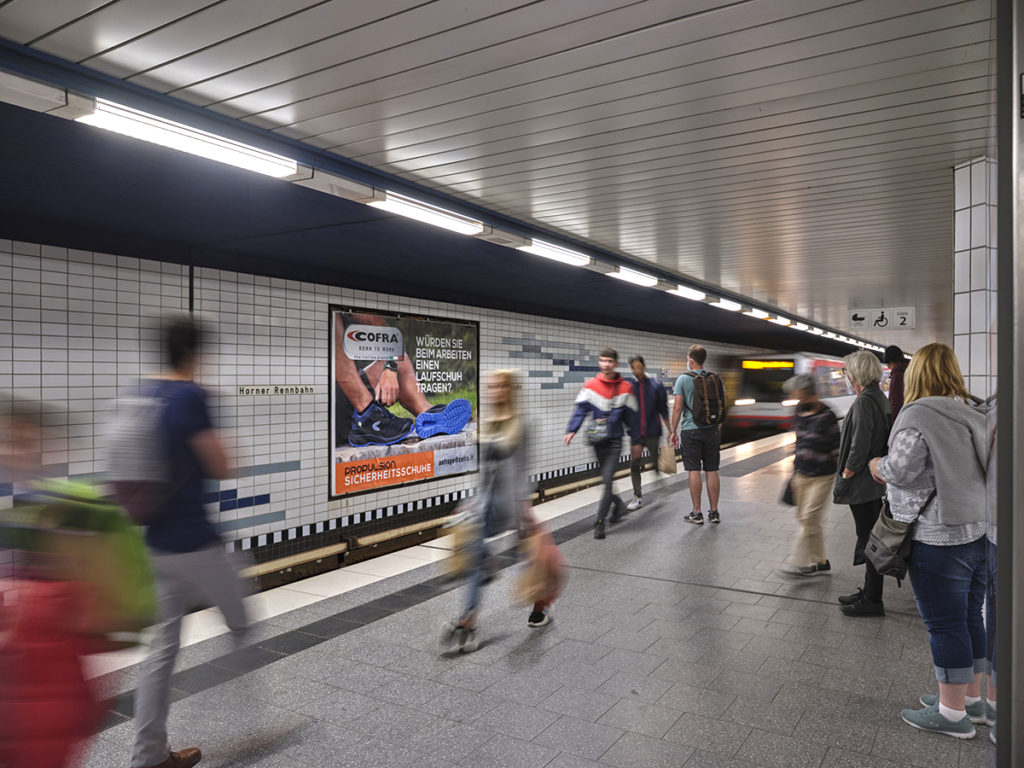
In the fall of 2022, Cofra launched a campaign with billboard advertising at 100 large-scale locations across Germany. Sounds random, but it wasn’t. Let’s illustrate the process with this appropriate example.
So, we asked ourselves this chain of questions:
What is the product to be advertised?
Who should buy the product?
Where is the target group and how do I reach the target audience?
The first two questions are easy to answer because the product and the target audience were clear. Cofra wanted to promote the product the Propulson safety shoe. On the one hand, this was intended to expand awareness of the Cofra brand in Germany and, in the process, increase sales of this shoe. With the claims “born to work” and “wear when working […]” the target group is also clear: workers from industry and trade. Precisely those who need safety shoes due to work with heavy equipment. But how and where to reach this target group?
In order to reach the target group, certain industrial areas were determined in the vicinity of major German cities, where, conversely, many workers from these industries are located.
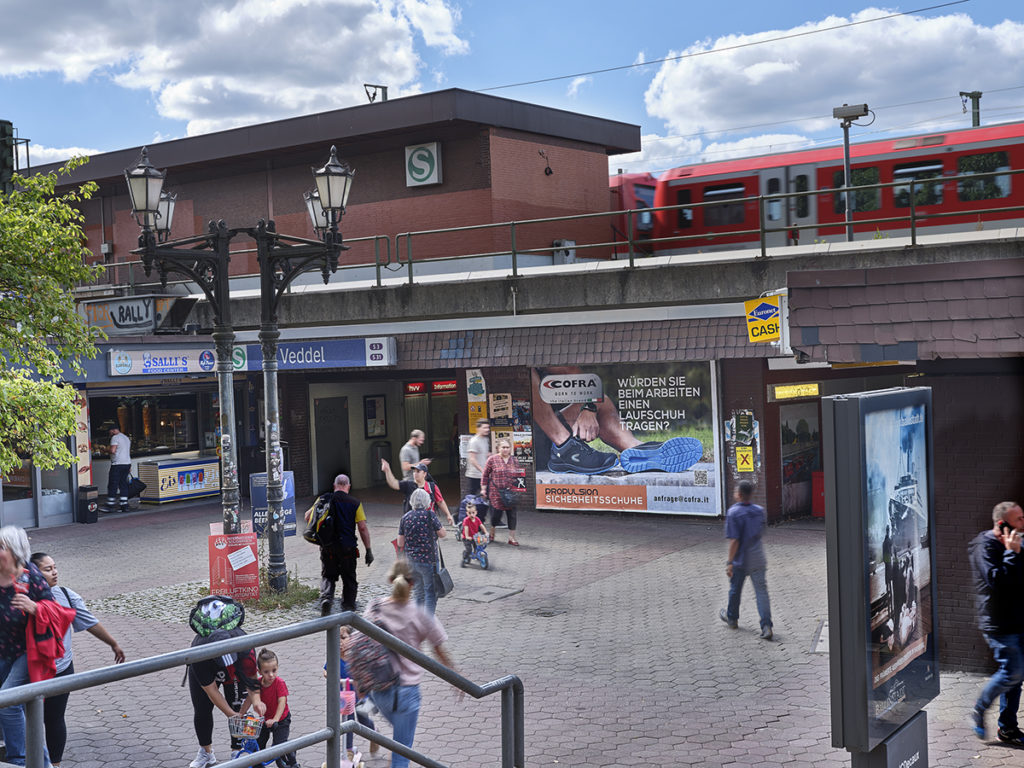
Advertising space was then sought in a certain radius around these industrial areas. Since the billboard format is very consistently found in the same format throughout Germany, the choice fell quite quickly on this billboard format.
The campaign shows very well how a product, the Propulsion safety shoe, can be advertised very specifically to its target group, workers in the vicinity of German industrial areas.
What makes the large-scale „Großfläche“ a classic of billboard advertising? It is popular and it works! This billboard advertising on these large panels is possible across Germany in the same format. This means that graphic designers create a format, the 18/1 format (approx. 9 m²), and the posters can be placed in exactly the same format in most cities in Germany. So, the graphic designer is happy. What about the media planner? They are happy, too! Because large-scale billboards can be selected individually. Wherever the advertiser’s target group is located, the „Großfläche“ can be selected exactly there and put together to form an individual network. There are numerous large-scale billboards in large and small cities around Germany. They are strategically placed at high-frequency locations, on major streets, at train stations, in bus or tram shelters, but also at the point of sale, i.e. in front of shopping centers, in supermarket parking lots, and in pedestrian zones. Anywhere where people see billboard advertising. Therefore, large-scale billboards are a popular classic with advertisers who want to use billboard advertising to reach their customers locally or even nationally across Germany.
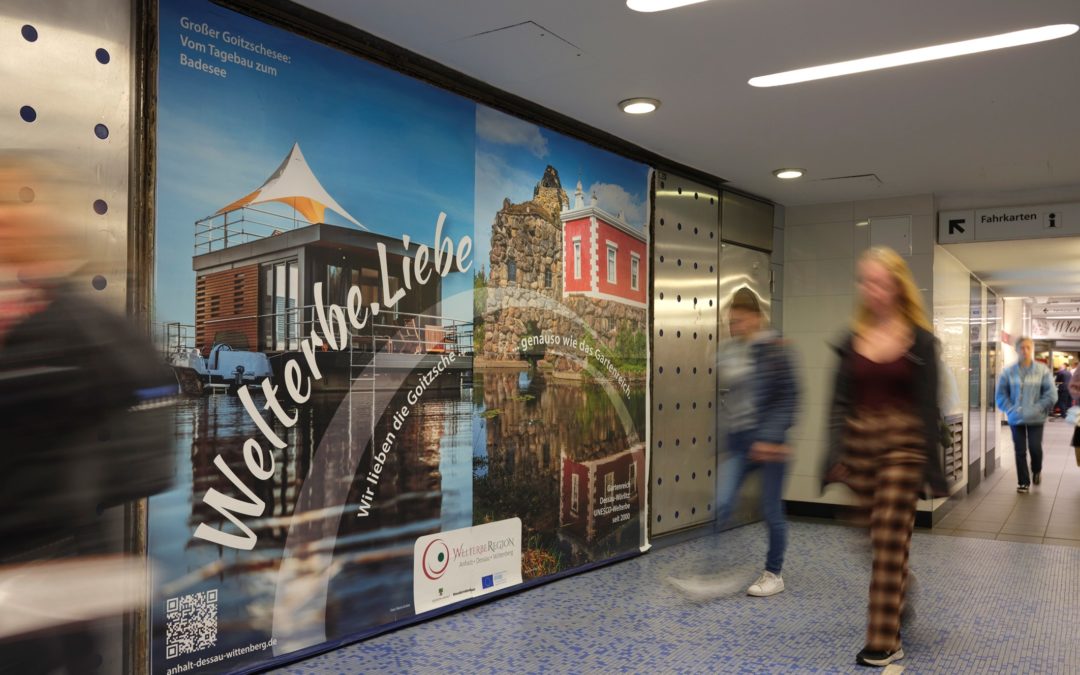
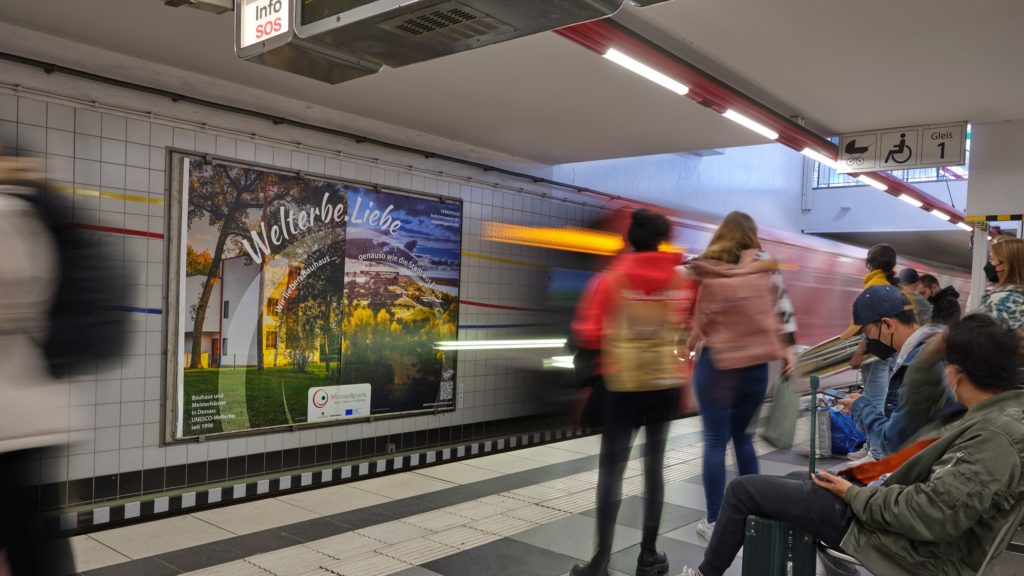
Our customer, the World Heritage Region Anhalt-Dessau-Wittenberg, also loves large-scale billboards! Large-scale billboards also offer a lot of space to work with large images. With its slogan “World Heritage Love”, the region advertises its most beautiful sites and attractions, including the iron Ferropolis, beautiful bike paths and cultural sites, such as the UNESCO World Heritage Garden Kingdom of Dessau-Wörlitz. The poster viewer is invited to visit the World Heritage region with beautiful photographs. This is how the region boosts tourism.
With 6 different motives large-scale billboards were placed across Germany. Not randomly, of course. But exactly in the source markets of the World Heritage Region: Berlin, Hamburg, Halle, Leipzig, Magdeburg, and North Rhine-Westphalia (Cologne, Düsseldorf, Münster, Mönchen-Gladbach and Paderborn). What a reach!
On average, drivers spend 41 hours a year looking for a parking space. In the capital Berlin, the frustration even extends to 62 hours a year. The solution: parking garages, with sufficient free parking spaces, in close proximity to the destination. Your advantage: With parking garage advertising, you can advertise effectively not far from your location, direct customers to you and become an impulse generator shortly before the purchase decision. Outdoor advertising as it lives and breathes.
The direct purchase decision maker: OOH in parking garages
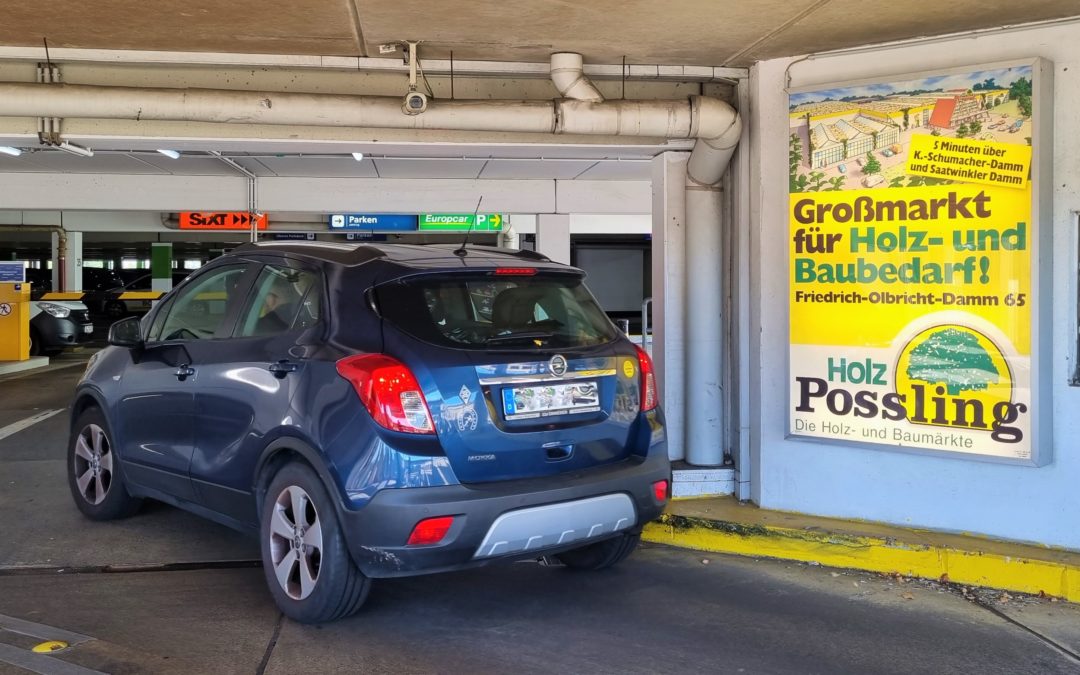
Parking garages are usually the starting point for shopping activities, so you can reach people with parking garage media directly on the way to the purchase decision. This means your OOH campaign can act as an impetus to buy or as an invitation to visit the store – the POS (point of sale). Therefore, this outdoor advertising is particularly effective for surrounding stores, restaurants, etc., which are within walking distance of the advertising. Place your advertising where your target group consumes. With billboard advertising in parking garages, you appeal especially to drivers, shopping enthusiasts, high-income earners, but also large families. Use an individual out-of-home campaign to make your target audience remember you and actively influence their purchasing decisions.
Eye-catching advertising with parking media (CLP or large-scale billboard)
Since the high-quality OOH faces are placed in an extremely conspicuous manner, i.e. along the driving paths and visual axes, your advertising is in the optimal field of vision of the parking garage guests. Often, the parking garage media are also placed directly next to the entrance or passage to the shopping center, or directly next to the pay station. In this way, visitors to the parking garage come into direct contact with the poster panels.
Whether you prefer City Light Posters or large-scale billboards, the advertising media are equally attractive and create a stir in the parking garages! CLPs impress with their backlighting, whereas large panels offer a striking amount of advertising space. Either way, billboard advertising in parking garages offers a wide range of options for successful advertising. We will be happy to advise you on which sign advertising will deliver the best results for your marketing activities.
Advertise for short, impulse campaigns or as large-scale permanent advertising, with parking garage advertising you benefit from cost-effective poster advertising and a very good campaign performance level, because: The high frequency of use of parking garages generates a high contact rate. In addition, parking garage advertising space can be booked throughout Germany, regardless of whether these are public parking garages or those adjacent to shopping centers. For surrounding businesses, out-of-home advertising with parking garage advertising is an effective advertising measure.
According to the urban dictionary, knorke is a German version to say “cool”. So, in June 2022, the Italian payment processing app Satispay launched a big, and knorke, campaign with billboard advertising in Berlin Kreuzberg and Neukölln, in order to increase brand awareness and app downloads in Berlin. They had acquired stores around Kreuzberg and northern Neukölln that accept their payment service. They now wanted to target Kreuz-Köllners with billboard advertising on 11 full columns, 1 City Light column, and 105 large-scale billboards on the street, as well as the digital City Light poster network HUB Kreuzberg, other large-scale billboards on subway stations, and some ground posters. Since the area was relatively small, booking this large number of different poster media created enormous advertising pressure. If possible, poster panels were also booked next to each other, on which different motifs were then placed. Satispay was simply unmissable in Berlin Kreuzberg!
The billboard advertising was also unmissable because of the clever motifs! Satispay placed cool characters on their motifs, that were resembling stereotypes of the target group from Berlin Kreuzberg and north Neukölln. With slogans like pay knorke, pay smart, pay schnieke, pay funky, or pay smart, they motivated the poster viewer to download the app. The bright red background also made the posters particularly eye-catching. In short, the red posters with clever slogans could be seen everywhere in the target area.
Great motifs! Great advertising pressure! Great campaign!
Also, do you want to see how the billboards are pasted onto a full column? Check out our youtube clip about it!
You think out-of-home advertising can’t be green? Posters and foils that are produced only to be displayed for a short time are not sustainable, you say? And anyway, what does all this have to do with the American Blockchain Algorand? Let’s clear things up!
On May 14-15, 2022, the ABB FIA Formula E World Championship, the race of electric-powered Formula 1 vehicles, took place at the old Tempelhof Airport site in Berlin. Since the focus is on electrically powered vehicles, we have a clear “green” finger pointing to sustainability, here, and away from fossil fuels. Furthermore, the visitors of the event are mostly men. This target group, men with an interest in sustainability, is clearly the focus for Algorand. Is this perhaps why Algorand is so present at this event and a proud partner of the Envision Formula-E team? Makes sense!
Algorand is a proof-of-stake blockchain protocol for cryptocurrencies that has had a strong focus on sustainability, energy efficiency, and environmental sustainability from the beginning. Not only because of this, Algorand presents itself as a green blockchain, but in addition to the Algorand Blockchain, the associated Algorand Foundation also cares about the growth of the ecosystem. So they are working to ensure that there are not only technologies for the future, but that the next generations can use these technologies on a livable planet. It’s a holistic, “green” idea and USP ) unique selling point) that makes Algorand stand out with.
Algorand’s green advertising campaign in Berlin
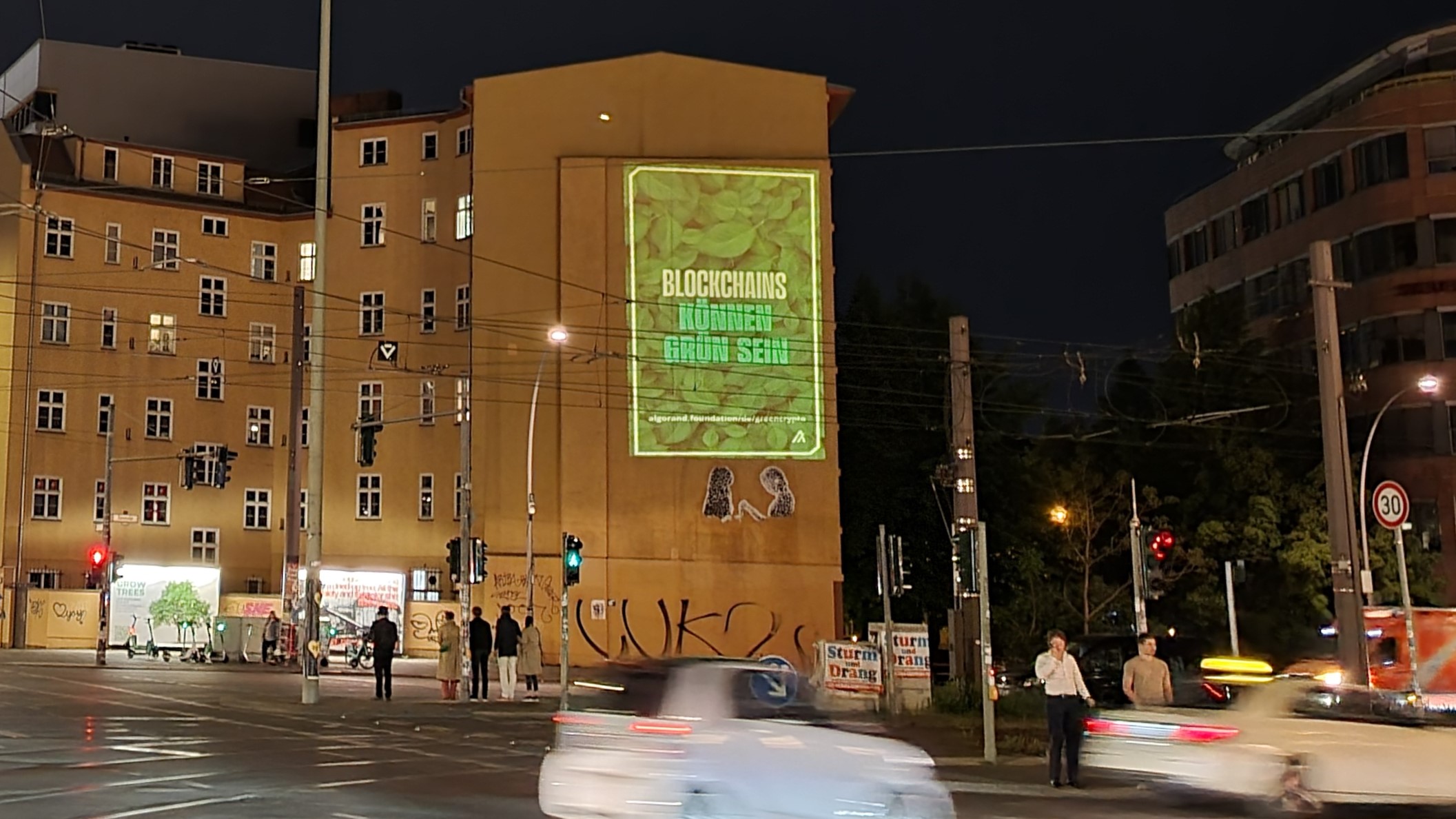
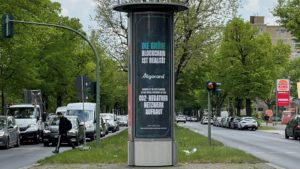
To address their target group for the Formula-E event, Algorand wanted to run an advertising campaign in the time leading up to and around the event to generate as much visibility as possible around the event location (Tempelhof Airport) and in Berlin. Together with their agency Funday Agency, we organized the greenest possible media mix. In addition to posters on largescale billboards, columns and city light columns, digital city light boards, digital projections and a CO2-absorbing giant poster were also placed to create a strong advertising impact.
But printed posters aren’t green, you say? Did you know that our poster printing partners are working on sustainability? They carry the Blue Angel eco-label, source energy from hydroelectric plants, distribute their sites to greatly reduce delivery distances, and recycle old posters afterwards. Quite a green approach.
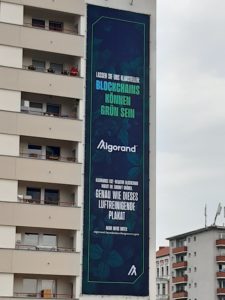
The giant poster, which was placed directly at the major intersection Platz der Luftbrücke on a facade opposite Tempelhof Airport, was intended to make a special statement. Algorand insisted that the giant poster be made with “the Pure,” a photocatalytic protective layer of titanium dioxide that cleans the air of pollutants: a CO2-absorbing giant poster! If it’s going to be a big printed banner, then please make it sustainable! To make that clear to prospective customers, the message on the mega poster read, “Blockchains can be green. Algorand’s CO2-negative blockchain is making the future greener, just like this air-purifying billboard.”
Want some more eco-friendly out-of-home advertising? To increase visibility around the event location and in Berlin-Mitte, two digital projections each were installed at different locations over 6 nights. The digital giant posters can be projected on different house walls in Berlin, in different sizes. Especially after sunset, the digital projections shine razor-sharp and through moving images they are a real eye-catcher!
In summary: a great campaign! With out-of-home advertising at events, advertisers always benefit from increased contact numbers. But at this event, Algorand also reaches their target group directly. With the direct partnership to the Formula-E team, they built a relationship with the poster viewer, drew the connection to sustainability and thus to their blockchain. Simply great!

 You want to place out-of-home advertising for a certain timing or around a certain place, but the desired advertising media are no longer available? Particularly in the case of billboard advertising, the good locations are often booked up well in advance. Especially, at certain events or trade fairs, the relevant advertising faces are often gone quickly. Therefore, it pays to plan in advance.
 Public transport advertising, such as advertising on or in cabs, trams, buses, subways and commuter trains, also offers many available vehicles for exterior wrapping and designated frames for interior advertising. For example, there are approximately 18,000 slots in the Berlin subway for the format ‘sidestripe’.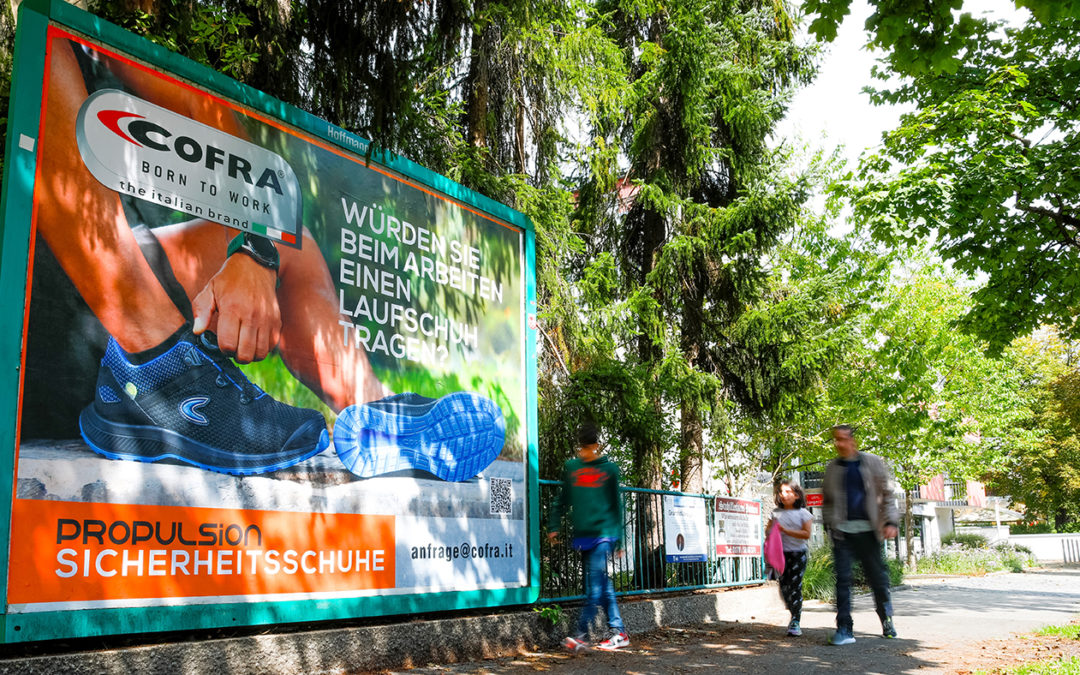
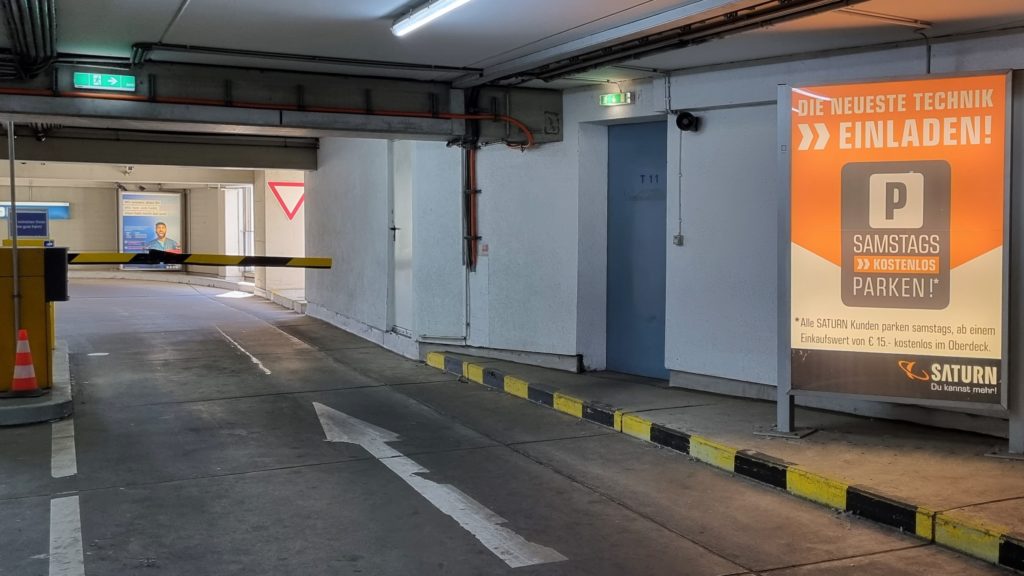 Parking garages are usually the starting point for shopping activities, so you can reach people with parking garage media directly on the way to the purchase decision. This means your OOH campaign can act as an impetus to buy or as an invitation to visit the store – the POS (point of sale). Therefore, this outdoor advertising is particularly effective for surrounding stores, restaurants, etc., which are within walking distance of the advertising. Place your advertising where your target group consumes. With billboard advertising in parking garages, you appeal especially to drivers, shopping enthusiasts, high-income earners, but also large families. Use an individual out-of-home campaign to make your target audience remember you and actively influence their purchasing decisions.
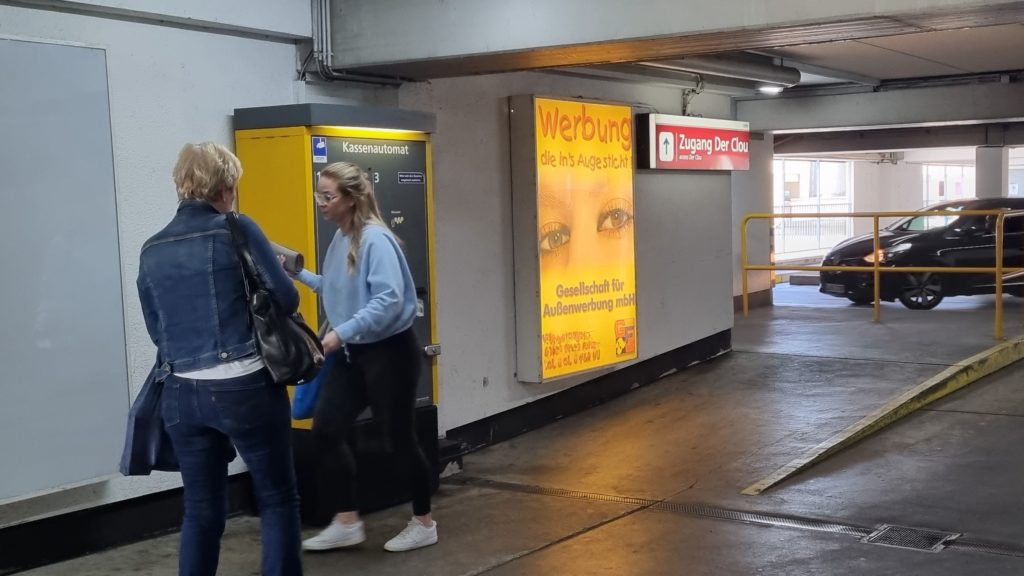 Whether you prefer City Light Posters or large-scale billboards, the advertising media are equally attractive and create a stir in the parking garages! CLPs impress with their backlighting, whereas large panels offer a striking amount of advertising space. Either way, billboard advertising in parking garages offers a wide range of options for successful advertising. We will be happy to advise you on which sign advertising will deliver the best results for your marketing activities.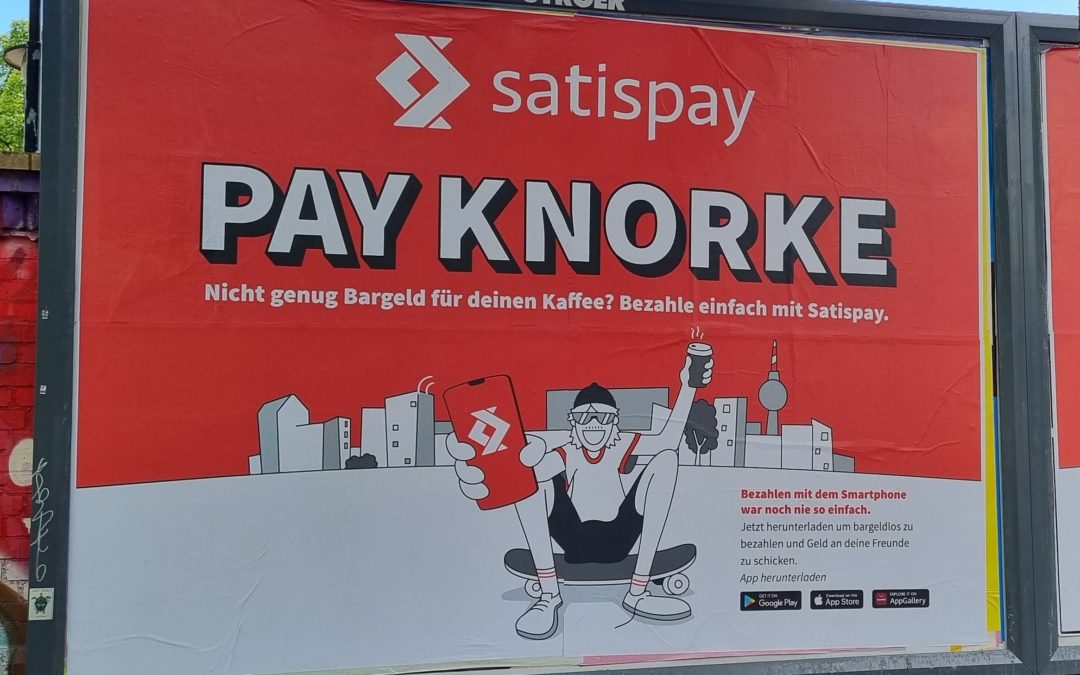
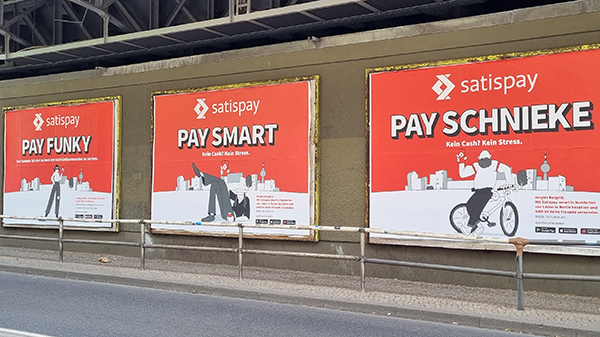 The billboard advertising was also unmissable because of the clever motifs! Satispay placed cool characters on their motifs, that were resembling stereotypes of the target group from Berlin Kreuzberg and north Neukölln. With slogans like pay knorke, pay smart, pay schnieke, pay funky, or pay smart, they motivated the poster viewer to download the app. The bright red background also made the posters particularly eye-catching. In short, the red posters with clever slogans could be seen everywhere in the target area.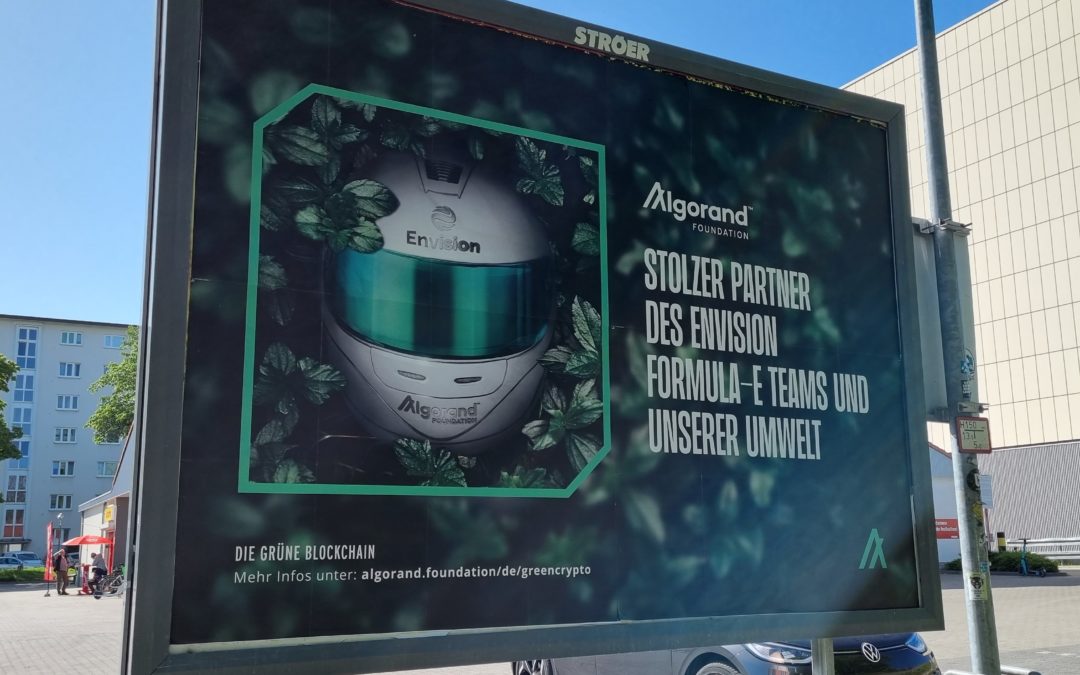
 Algorand is a proof-of-stake blockchain protocol for cryptocurrencies that has had a strong focus on sustainability, energy efficiency, and environmental sustainability from the beginning. Not only because of this, Algorand presents itself as a green blockchain, but in addition to the Algorand Blockchain, the associated Algorand Foundation also cares about the growth of the ecosystem. So they are working to ensure that there are not only technologies for the future, but that the next generations can use these technologies on a livable planet. It’s a holistic, “green” idea and USP ) unique selling point) that makes Algorand stand out with.
 But printed posters aren’t green, you say? Did you know that our poster printing partners are working on sustainability? They carry the Blue Angel eco-label, source energy from hydroelectric plants, distribute their sites to greatly reduce delivery distances, and recycle old posters afterwards. Quite a green approach.